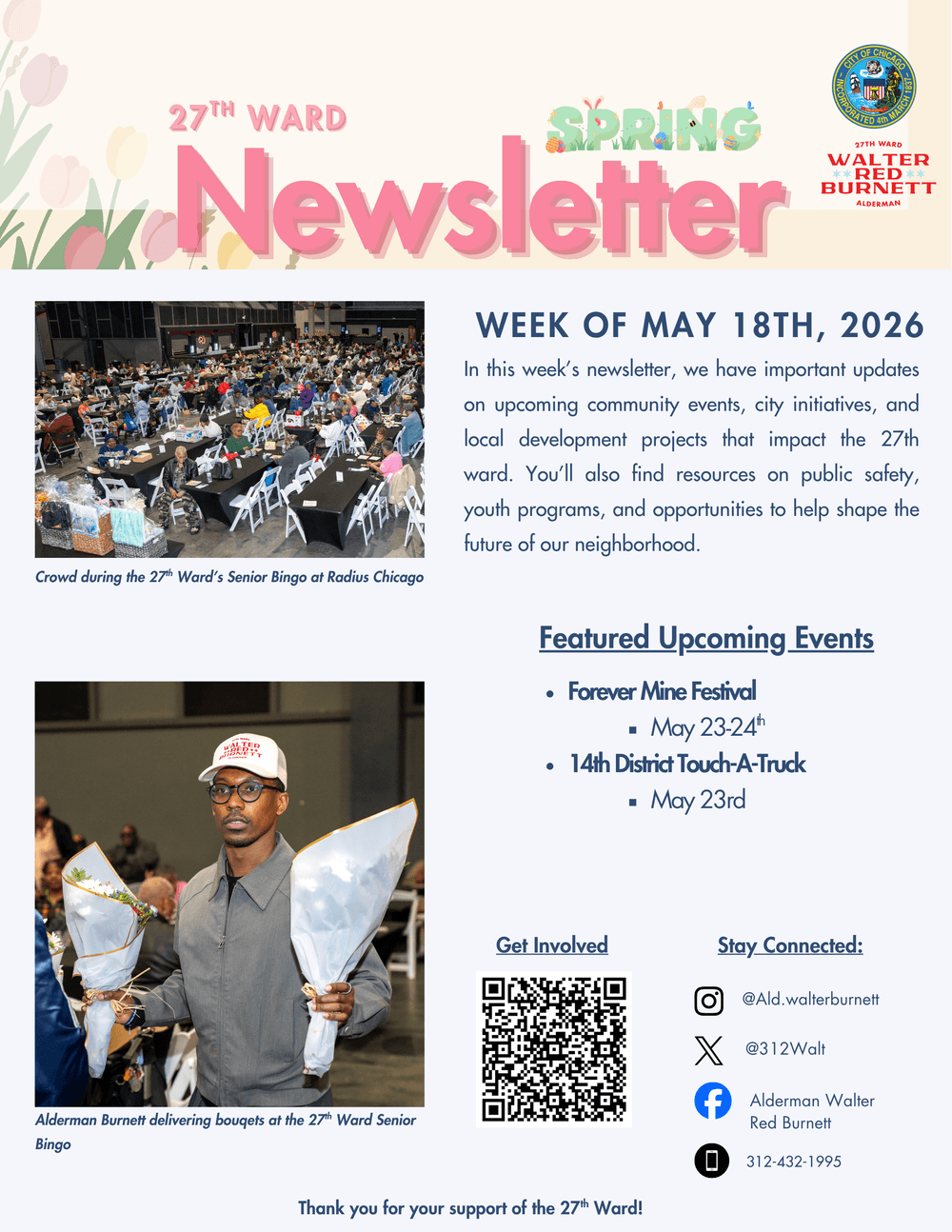
Welcome to the 27th Ward Newsletter! Dear Neighbors, This week at City Hall reminded me that governing a city is often an exercise in holding two truths at the same time. Chicago must grow. And the people who built Chicago must be able to grow with it. That tension sits underneath nearly every major vote we take. It is present in conversations about development, wages, public safety, taxes, transportation, and housing. It shapes the decisions we make about where investment goes, who benefits from it, and whether everyday residents feel like they still have a place in the future of this city. This week, two major pieces of legislation I helped lead moved through the City Council with broad support. On paper, they deal with very different issues. But to me, they are connected by the same question: How do we move Chicago forward without leaving people behind? The first was the United Center 7b Tax Incentive tied to the 1901 Project — the transformational redevelopment planned for the land surrounding the United Center. For decades, those parking lots have acted like a moat between the West Side and the West Loop. Thousands of people pass through the area for games and concerts, yet much of the surrounding land has remained underutilized. What should be connective tissue for the city has instead operated like empty space. I support this project because cities cannot stand still and expect to compete. Chicago has always been a city that built big things. Railroads. Skyscrapers. Lakefront parks. Neighborhood corridors. Public transit systems. We are at our best when we are confident enough to invest in ourselves. The 1901 Project represents a $7 billion private investment in Chicago. The public incentive attached to it — roughly $55 million — represents less than one percent of the total project cost. That support helps fund infrastructure and public improvements that make large-scale development possible: streets, parks, parking, and the connective pieces that do not always generate profit on their own but are necessary for a neighborhood to function well. Still, I understand why people hear the words “tax incentive” and immediately think about displacement. Those concerns are not theoretical to me. I grew up around the United Center. I still live nearby. I have watched property values rise, blocks change, and longtime residents worry whether there will still be room for them in the neighborhoods they helped hold together during harder years. Growth without inclusion creates resentment. Development without participation becomes extraction. And gentrification begins the moment the people who stayed through the struggle no longer have access to the opportunity created by the success. That is why I have pushed consistently for workforce opportunities, community hiring, subcontracting participation, and neighborhood investment alongside this development. If this project succeeds, the West Side should not simply watch it happen. The West Side should benefit from it. The United Center organization has already demonstrated a willingness to engage with the surrounding community through hiring fairs, local partnerships, and investment initiatives. My responsibility is to continue making sure those commitments deepen as the project moves forward. Because vacant land in the center of a major city does not help neighborhoods grow. It does not strengthen the tax base. It does not create jobs. It does not create wealth. Investment matters. But who participates in that investment matters even more. The second major item this week involved the ongoing debate around One Fair Wage. This issue has become deeply polarizing because it touches something personal for so many people: survival. Workers want fair pay and economic dignity. Restaurant owners are trying to survive rising costs and shrinking margins. And both sides are telling the truth about the pressure they are under. Back in 2023, the City passed the original One Fair Wage ordinance, championed by Mayor Brandon Johnson, which set Chicago on a path toward phasing out the tipped wage credit. Earlier this year, the Council attempted to repeal the ordinance entirely and permanently preserve the subminimum wage structure. The Mayor vetoed that repeal, and the Council ultimately failed to override it. During that debate, I introduced a compromise because I did not believe either extreme fully addressed the reality in front of us. I do not believe workers should remain trapped indefinitely in a system that leaves income unstable and unpredictable. But I also do not believe we can ignore what neighborhood restaurants are facing right now. Restaurants are being squeezed from every direction at once: food costs, labor costs, rent, utilities, insurance, supply chain instability, tariffs, and inflation. Many small operators are still recovering from the pandemic while trying to compete in an economy that has fundamentally changed. If government moves too quickly without accounting for those pressures, the unintended consequences often land on the very workers we are trying to help. Hours get cut. Staffing shrinks. Independent restaurants close. And once neighborhood restaurants disappear, they rarely come back. The compromise ordinance freezes the tipped credit structure for two years while allowing smaller businesses additional time to adapt. It keeps Chicago moving toward a full minimum wage while also acknowledging the economic reality many businesses are navigating today. More importantly, it creates space to study the data honestly instead of arguing purely from ideology. We need to examine what is actually happening to wages, employment, tipping patterns, restaurant closures, and worker stability before making permanent decisions that affect thousands of families across the city. Because good policy is rarely built through slogans. It is built through balance, adjustment, and honesty. That is the work of governing. Not choosing easy sides. Not performing outrage. But sitting in the tension long enough to find solutions that allow a city to keep moving forward together. Whether the issue is economic development, labor policy, public safety, or neighborhood investment, my approach remains the same: Chicago has to grow, but growth has to mean something for the people already here. The neighborhoods that carried this city through disinvestment, population loss, and violence deserve more than promises after prosperity arrives. They deserve a stake in the future being built around them. That is what I will continue fighting for at City Hall. Thank you for continuing to stay engaged, ask questions, and remain part of these conversations. Public trust is built when residents stay involved, and I remain grateful for the opportunity to serve the 27th Ward. Sincerely, Walter “Red” Burnett Alderman, 27th Ward |